
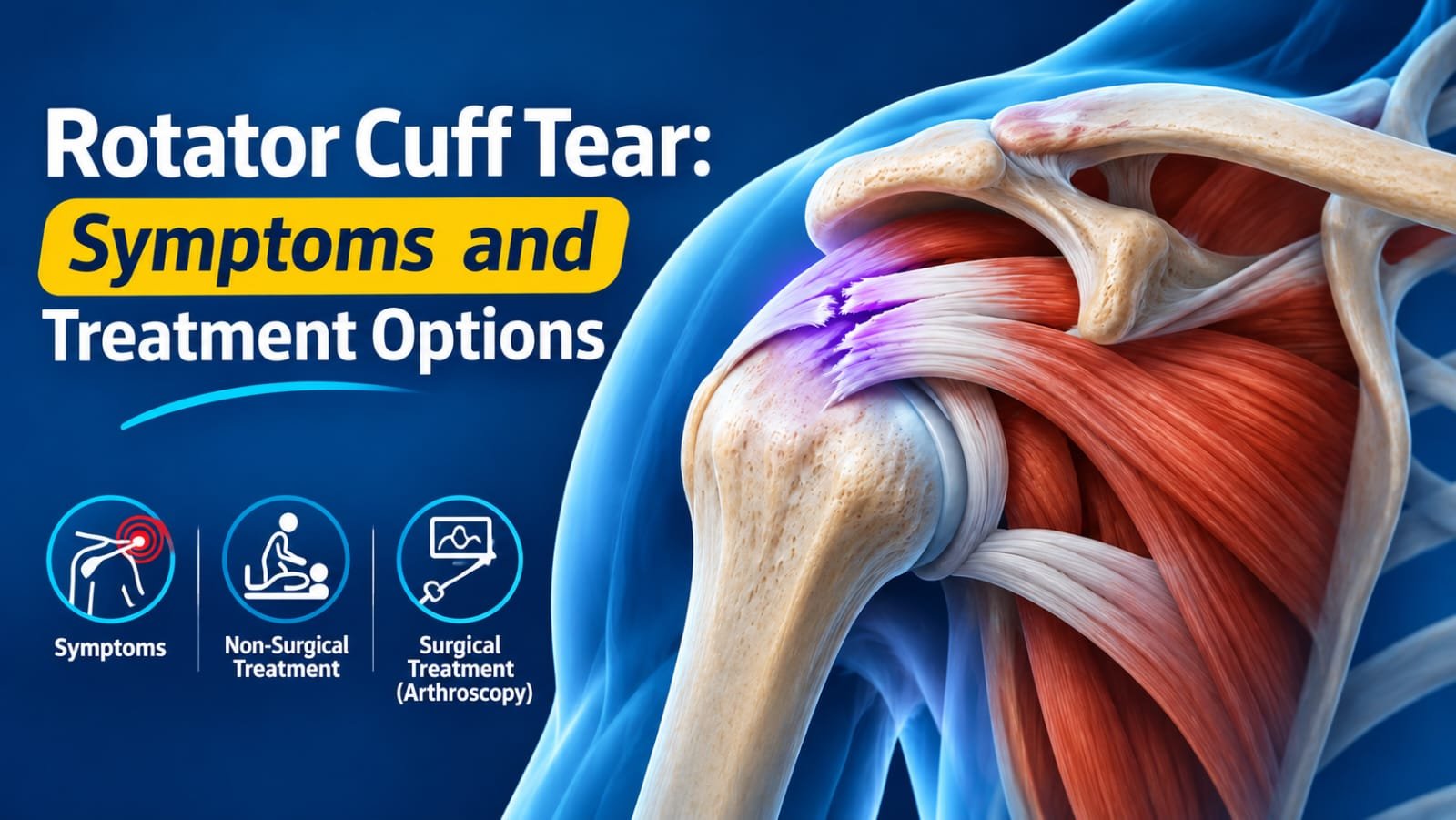
If you have a deep ache in your shoulder that worsens at night, or you struggle to lift your arm to comb your hair or reach a shelf, a rotator cuff injury could be the cause. It is one of the most common reasons for shoulder pain in adults, and the right care starts with an accurate diagnosis. Whether your tear needs rest and physiotherapy or a minimally invasive procedure like shoulder arthroscopy in Kolkata, understanding your options early helps protect your shoulder for the long term.

What Is a Rotator Cuff?
The rotator cuff is a group of four muscles and their tendons that surround the shoulder joint. They keep the ball of the upper arm bone (humerus) centered in the shallow socket of the shoulder blade, and they allow you to lift and rotate your arm. When one or more of these tendons is torn, the shoulder loses strength and stability.
Types of Rotator Cuff Tears
- Partial tear: The tendon is frayed or damaged but not completely severed.
- Full-thickness tear: The tendon is torn all the way through, sometimes detaching from the bone.
- Acute tear: Happens suddenly, often after a fall or while lifting something heavy.
- Degenerative tear: Develops gradually from wear and tear, and is more common after age 40.
Common Causes and Risk Factors
- Falls or direct injury to the shoulder
- Repetitive overhead movements, such as painting, carpentry, cricket, or swimming
- Age-related tendon degeneration
- Poor blood supply to the tendons as we age
- Bone spurs that rub against the tendon
- Previous shoulder injuries
Symptoms of a Rotator Cuff Tear
Symptoms vary depending on the size and type of the tear. Watch for:
- Dull, deep ache in the shoulder, especially at night or when lying on the affected side
- Pain when lifting or lowering the arm
- Weakness in the shoulder or arm
- Difficulty reaching behind your back or overhead
- A clicking or popping sensation during movement
- Limited range of motion
- A sudden, sharp pain with immediate weakness after an injury
Many people ignore early symptoms and assume the pain will pass. But small tears can grow over time, and delaying treatment can make recovery more difficult.
How Is a Rotator Cuff Tear Diagnosed?
Your orthopedic surgeon will begin with a physical examination, checking your range of motion, strength, and pain triggers. Imaging tests help confirm the diagnosis:
- X-ray: Rules out bone spurs, arthritis, or fractures.
- Ultrasound: Shows tendon tears and is useful for dynamic assessment.
- MRI: Gives a detailed view of the tendon, the size of the tear, and the condition of the muscle.
Treatment Options for Rotator Cuff Tear
Treatment depends on the type of tear, your age, activity level, and how much the pain affects daily life.
Non-Surgical Treatment
Many partial tears and some degenerative tears improve without surgery. Options include:
- Rest and avoiding activities that aggravate the shoulder
- Anti-inflammatory medication, as advised by your doctor
- Physiotherapy to strengthen the surrounding muscles and improve motion
- Corticosteroid injections in selected cases to reduce pain and inflammation
Surgical Treatment
Surgery may be recommended if you have a full-thickness tear, an active lifestyle, significant weakness, or pain that does not improve after several months of conservative care. Today, most repairs are done through arthroscopy surgery in Kolkata, which uses small incisions and a tiny camera to repair the torn tendon back to the bone. Compared with open surgery, arthroscopic repair typically means less tissue damage, smaller scars, and a more comfortable early recovery. For very large or long-standing tears, other options such as tendon transfers or reverse shoulder replacement may be considered.
Recovery After Rotator Cuff Repair
Recovery is gradual and needs patience. Most patients wear a sling for a few weeks to protect the repair. Gentle movement begins early under guidance, followed by progressive strengthening. Full recovery commonly takes several months, and following the physiotherapy plan closely is key to a good result.
When Should You See a Doctor?
Don’t wait if you notice:
- Shoulder pain lasting more than a few weeks
- Pain that disturbs your sleep
- Sudden weakness after a fall or injury
- Difficulty performing everyday tasks like dressing or lifting
Early evaluation can prevent a small tear from becoming a larger one and may widen your treatment choices. If shoulder pain is affecting your life, book a consultation with Dr. Reet Mukhopadhyay for a proper diagnosis and a treatment plan tailored to you.
Frequently Asked Questions
- Can a rotator cuff tear heal on its own?
A partial tear may improve with rest and physiotherapy, but a full-thickness tear does not heal back to the bone on its own. Even when pain settles, the tear can remain, so it is best to have it assessed. - What does rotator cuff tear pain feel like?
It is usually a deep, dull ache in the shoulder that often worsens at night or when you lift your arm. Weakness and difficulty reaching overhead or behind the back are also common. - Do all rotator cuff tears need surgery?
No. Many partial and degenerative tears are managed well with physiotherapy, medication, and activity modification. Surgery is usually advised for full-thickness tears, significant weakness, or when non-surgical treatment fails. - How long is the recovery after rotator cuff surgery?
Most patients need a sling for a few weeks, followed by guided physiotherapy. Return to daily activities usually takes a few months, while full strength and sports may take longer depending on the tear size and your rehabilitation. - What happens if a rotator cuff tear is left untreated?
A tear can enlarge over time, leading to more pain, increasing weakness, stiffness, and sometimes permanent changes in the shoulder muscles and joint. Early treatment gives better outcomes.
