
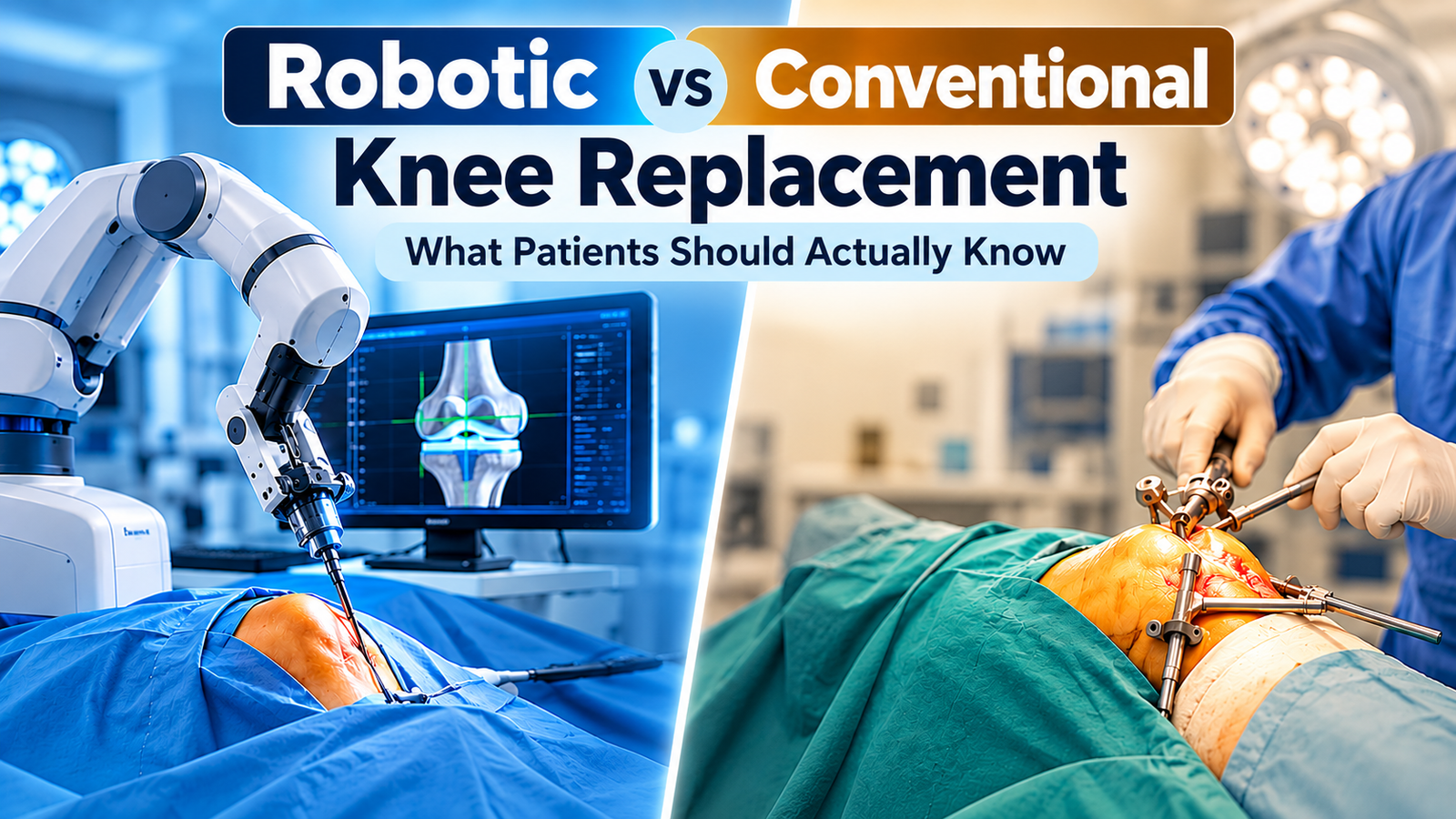
If knee pain is limiting your walking, stairs, or sleep, and your doctor has advised surgery, you have probably come across a new question: should you choose robotic or conventional knee replacement? Advertisements, social media posts, and hospital brochures often make robotic surgery sound like the clearly superior choice. The reality is more balanced.

This guide explains how both approaches work, where they differ, and what you should ask before deciding.
When Is Knee Replacement Needed?
Knee replacement is usually recommended when arthritis or joint damage has worn away the cartilage, leaving bone rubbing on bone. Typical signs include:
- Persistent knee pain even at rest or at night
- Stiffness and swelling that limit daily activity
- Difficulty climbing stairs or getting up from a chair
- Bowing of the legs or visible deformity
- Little or no relief from medicines, injections, or physiotherapy
Surgery replaces the damaged surfaces with a metal and plastic implant. A total knee replacement surgery is one of the most successful procedures in orthopedics, and both the robotic and conventional methods aim for the same result: a pain-free, stable, well-aligned knee.
What Is Conventional Knee Replacement?
In conventional surgery, the surgeon plans the operation from X-rays and uses mechanical guides and cutting blocks to prepare the bone. The implant is then fitted and its position checked by the surgeon’s eye, measurements, and experience.
This technique has been used for decades and has an excellent long-term record. Its results depend heavily on the surgeon’s skill, which is why choosing an experienced surgeon matters more than any technology.
What Is Robotic Knee Replacement?
Robotic-assisted knee replacement does not mean a robot operates on its own. The surgeon still makes every decision and controls the procedure. The robotic system supports the surgeon in several ways:
- It uses a CT scan or real-time mapping to build a 3D model of your knee.
- It helps plan the exact size and position of the implant.
- It guides or limits the bone cuts so they stay within the planned boundaries.
- It helps balance the soft tissues around the knee during surgery.
The goal is greater precision and a more personalized fit for your anatomy.
Robotic vs Conventional: Key Differences
- Accuracy and alignment. Robotic systems can place the implant very close to the surgical plan, with small, repeatable cuts. Conventional methods can also achieve good alignment in experienced hands, but there is slightly more room for variation.
- Soft tissue protection. Because robotic tools can restrict cutting to the planned area, they may help protect the ligaments and tissues around the knee.
- Early recovery. Some patients report less pain and quicker early mobility after robotic surgery. However, studies do not show a large difference for every patient, and recovery also depends on your age, fitness, and rehabilitation.
- Long-term results. This is the point most patients should know. Current evidence shows that both methods give very good long-term outcomes, and the long-term advantage of robotics over conventional surgery is still being studied. A well-done conventional replacement is not an “old” or inferior option.
- Cost and availability. Robotic surgery generally costs more because of the equipment, imaging, and disposables involved. It is also not available at every hospital.
- Surgical time. Robotic procedures may take a little longer because of the planning and setup steps, though this varies between teams.
Who May Benefit More From Robotic Surgery?
Robotic assistance can be particularly useful in some situations:
- Patients with significant deformity or unusual bone anatomy
- Younger, active patients who want the most precise alignment possible
- Cases where a very individualized implant position is desired
When Is Conventional Surgery a Good Choice?
Conventional surgery remains an excellent option for many patients, especially when:
- The knee anatomy is straightforward
- The surgeon has extensive experience with the conventional technique
- Cost is an important factor
- Robotic facilities are not easily accessible
What Matters More Than the Technology
The best result does not come from the machine alone. These factors have a bigger effect on your outcome:
- Surgeon experience: The number of knee replacements your surgeon has performed and their complication record.
- Proper patient selection: Whether surgery is truly the right step for you at this stage.
- Implant quality and sizing: Choosing the right implant for your body and activity level.
- Infection control: A clean operating environment and good hospital protocols.
- Rehabilitation: Starting physiotherapy early and following your exercise plan.
A skilled surgeon using conventional methods can achieve better results than an inexperienced surgeon using advanced equipment. Technology should support skill, not replace it.
Questions to Ask Before You Decide
Take these questions to your consultation:
- Is knee replacement the right step for me now, or can other treatments help first?
- Which technique do you recommend for my knee, and why?
- How many knee replacements have you performed using this method?
- What is the difference in cost, and is it justified in my case?
- What recovery timeline should I expect, and when can I return to normal activities?
If you are unsure whether you need a full replacement, your surgeon may first check whether a less extensive option helps. Early joint problems, such as meniscus or ligament injuries, can sometimes be treated with knee arthroscopy surgery before the joint wears out completely. And if both hips and knees are affected, a specialist in joint replacement surgeon Kolkata services can plan your treatment in a logical order.
Recovery After Knee Replacement
Whichever technique is used, recovery follows a similar path:
- Walking with support usually begins within a day of surgery.
- Physiotherapy starts early to restore movement and strength.
- Most people return to light daily activities within a few weeks.
- Full strength and comfort continue to improve over the following months.
Following your physiotherapy plan, managing swelling, and attending follow-up visits make a major difference to how well your new knee performs.
The Bottom Line
Robotic knee replacement offers real benefits in precision and personalization, but it is not essential for a successful result. Conventional knee replacement remains a proven, reliable option. The right choice depends on your knee, your goals, your budget, and, above all, the experience of your surgeon.
If knee pain is affecting your quality of life, a personal evaluation is the best next step. You can contact Dr. Reet to discuss your condition and the treatment that suits you.
Frequently Asked Questions (FAQs)
- Is robotic knee replacement better than conventional surgery?
Robotic surgery can improve precision and implant positioning, but current evidence shows that both methods provide very good long-term results. The better option depends on your anatomy and your surgeon’s experience. - Does a robot perform the surgery on its own?
No. The surgeon controls the entire procedure. The robotic system only assists with planning, guidance, and keeping the bone cuts within the planned limits. - Is recovery faster after robotic knee replacement?
Some patients experience less early pain and quicker mobility, but the difference is not the same for everyone. Recovery depends mostly on your general health, the surgery, and how well you follow rehabilitation. - Is robotic knee replacement more expensive?
Usually yes. The technology, imaging, and equipment add to the cost. Ask your hospital for a clear cost breakdown for both options. - How do I know which option is right for me?
Get a detailed evaluation from an experienced orthopedic surgeon. They will assess your X-rays, joint condition, age, and activity level, then recommend the technique that gives you the best and safest outcome.
